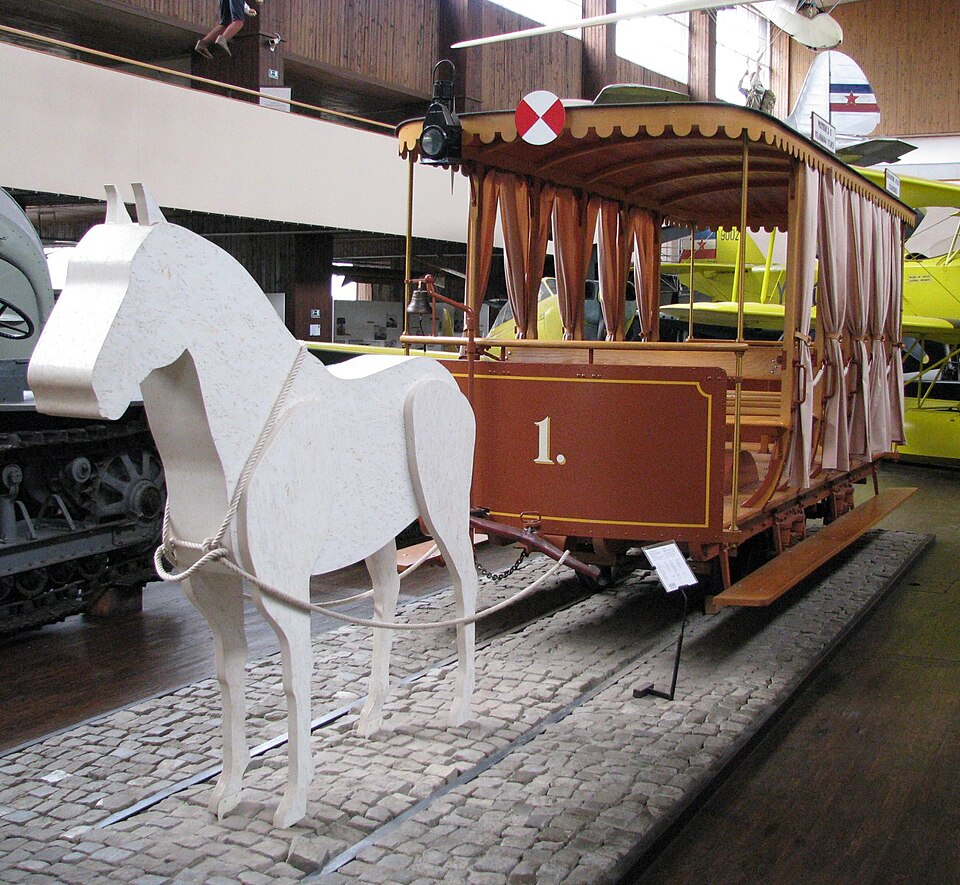
November the 2nd, 2026 – 135 years is the time period during which the now iconic blue Zagreb tram has snaked through the capital city. From being pulled by horses to new vehicles, let’s look back at the history of what we now know as ZET. Dubravko Grakalic reports for Index that frequent trams have been circulating Zagreb’s streets for 135 years now. They have become the blue symbol of the city, living history on the rails, and transport without which Zagreb can hardly function, something Zagreb residents felt most clearly during the recent multi-day ZET workers’ strike, which caused days of traffic problems until a court declared it illegal and banned it. horse-drawn trams named after vineyard pests… Ex13 The first tram circled Zagreb back in 1891. It was pulled by horses and was far from the technical modernity we know today. Zagreb’s trams were once yellow and ran on only a few lines through the very city centre. People affectionately called them “konjka” (horse-tram), but also mockingly “filoksera”, after the notorious wine louse (phylloxera) that was ravaging vineyards in those years, because the workers laying the tracks had dug up and torn apart half the city. Before the trams, passengers were transported around Zagreb by omnibuses that resembled stagecoaches from Western films. They ran from the city centre to the bathing spots on the Sava and from the railway station to a few hotels. As ZET explains, “the city fathers in Zagreb began discussing the need to introduce a horse-drawn tram as a means of transport” in 1885. French engineer Raoul Pierre Alexandre Gautier proposed a contract for the introduction of tram traffic to the Zagreb City Magistrate on the 20th of June 1887. The city municipality accepted his offer and on the 26th of March 1889 issued him a permit to build a tram line on the ground of the city streets. The Association of Engineers and Technicians allowed the construction of a 76-centimetre-wide track, and the Tramway Company, a special private enterprise, began work. The first tram depot was built on the site of today’s Nikola Tesla Technical Museum. ilica, zagreb’s modern main artery, was dug up zagreb.hr The first lines were built from the corner of Ilica and Mandaličina Street to Maksimir, from the corner of Ilica and Frankopanska Street to the Sava Bridge, and from the corner of Ilica and today’s Republic of Austria Street to the Western Railway Station. Construction began in May 1891, and the trams started running a few months later. Historian Lelja Dobronić, in the article “Old Notes on the Zagreb Tram” published in the magazine Kaj, cites a document from the 17th of August 1891: “Since the long-awaited rails from England and the carriages from Graz (in Austria) have finally arrived, Upper Ilica has been being dug up since last Thursday, and from today Frankopanska Street as well, so that the rails can be laid. Certainly by this Sunday the rails will be laid through the whole of Ilica and Jelačić Square. Up to 500 workers are working a day.” At the time when Zagreb’s trams were pulled by horses, there were ten closed and six open vehicles available, manufactured at the Weitzer factory in Graz. The average speed of the horse-drawn tram cars was 7.5 km/h. Zagreb’s horse-drawn tram also carried passengers in Velika Gorica, where the joint-stock company Horse Railway was founded back in 1907. They had a seven-kilometre line from the railway station, through the centre of Velika Gorica, to Novo Čiče. It was called “konjača.” After 1945 the horses were replaced by a small diesel locomotive. electrification and expansion The electric tram started in August 1910, but horse-drawn trams continued to operate for the following year. Zagreb’s trams changed colour in 1923. They became blue instead of yellow, while the vehicles were reconstructed. A new model, the M-24, manufactured in Zagreb and running on the right-hand track, also appeared on the streets. Summer open-air trams soon became available as well. During the time of the Independent State of Croatia (NDH), Zagreb’s trams ran with increasing difficulty because of bombing, and services were suspended in 1944. Traffic resumed after liberation, and in the autumn of 1945 tracks were built through Vodnikova and Mihanovićeva streets. From then on, the tram lines had numbers. In the following years lines were built towards Žitnjak as well as the Mihaljevac–Dolje line. A building for ZET workers was constructed in Puljska Street. bull, czech and katica… At the beginning of the 1950s, Zagreb’s residents also received the first domestically produced tram, built in the ZET workshop. It was prototype 101 with 95 passenger seats. This was followed by cooperation with the “Đuro Đaković” wagon factory from Slavonski Brod and the purchase of M-201 vehicles. The last example of the M-201 tram, nicknamed “Đuro” or “Bik” (Bull), ran until June 2024 on line 9. Its predecessor, the M-24, ran from 1924 to 1977. Today it is used as the Christmas tram. In 1977 Czechoslovak trams from the ČKD-Tatra factory in Prague were purchased. The Czech T4 model trams, known as “Čeh” (Czech), ran for years on lines 4, 6 and 14. Years later the Tatra KT4YU trams, better known as “Katice,” also arrived. An important date in the history of the Zagreb tram was the 25th of November 1979, when the line along Držićeva Street, across the Bridge of Youth, to New Zagreb was opened. That was when the tram crossed the Sava. In 1980 a tram-bus terminal was built at Črnomerec on the site of a former brickworks. In November 1985 the tram also started running across the Adriatic Bridge towards New Zagreb. Further development of ZET includes the abolition of the conductor’s job in 1996 (conductors had been cancelling and selling tickets in the vehicles for 105 years) and the extension of tram routes to Dubec and Prečko. and then came končar… Falk2 Over the last thirty years or so the old trams, Bulls, Czechs and Katicas, have been replaced by trams manufactured at Končar, Zagreb’s technological giant. “In more than 30 years of operation on Zagreb’s tram network, Končar trams have covered more than 140 million kilometres, confirming their quality, reliability and indispensable role in the lives of Zagreb residents,” Končar told Index. The company had already begun manufacturing electric rectifier stations for ZET back in 1954. “After almost three decades of cooperation on energy infrastructure, ZET and Končar began joint development of tram vehicles. Production of the TMK 2100 series trams began in 1993, and the prototype was presented on the 5th of September 1994 and immediately put into regular service,” the company notes, also recalling the TMK 2200 trams. “From June 2010 a total of 140 TMK 2200 series trams and two shorter TMK 2200-K trams (which carry the designation TMK 2300 in ZET’s fleet) have been produced for Zagreb,” Končar says. The company later also manufactured shorter trams for the Latvian city of Liepāja. zagreb’s blue trams In order to fill gaps in the timetable until the delivery of new vehicles, ZET bought 11 used GT6M trams from Augsburg, Germany, at the end of 2023 and during 2024. This sparked lively public debate because of their age and the fact that the passenger areas are not air-conditioned. The newest Zagreb trams, the TMK 2300, have been in service since February 2025, and there will be forty of them. Through their rich history Zagreb’s trams have become the city’s blue symbol, a mark of the development of domestic technology, and an indicator of Zagreb’s expansion ever further from its historic centre. Zagreb is, along with Osijek, the only Croatian city with tram traffic. Trams once also ran in Pula (from 1904 to 1934), Dubrovnik (from 1910 to 1970), and Rijeka and Opatija. The post 135 Years of the Zagreb Tram – From Horses to Modernity appeared first on Total Croatia .
November the 2nd, 2026 – 135 years is the time period during which the now iconic blue Zagreb tram has snaked thro
评论