
Longevity is a field that never lacks plausible advice. Wear less, eat less, expose yourself to cold: each has its advocates and its critics. The trouble is that most such claims stop at observation. People in some region live long and the region happens to be cool; a treatment makes cells more resilient but nobody can say which step does the work. Where the mechanism is empty, the conclusion easily turns into a belief. The appeal of a single causal story is obvious, and that is exactly why it has to be handled carefully.
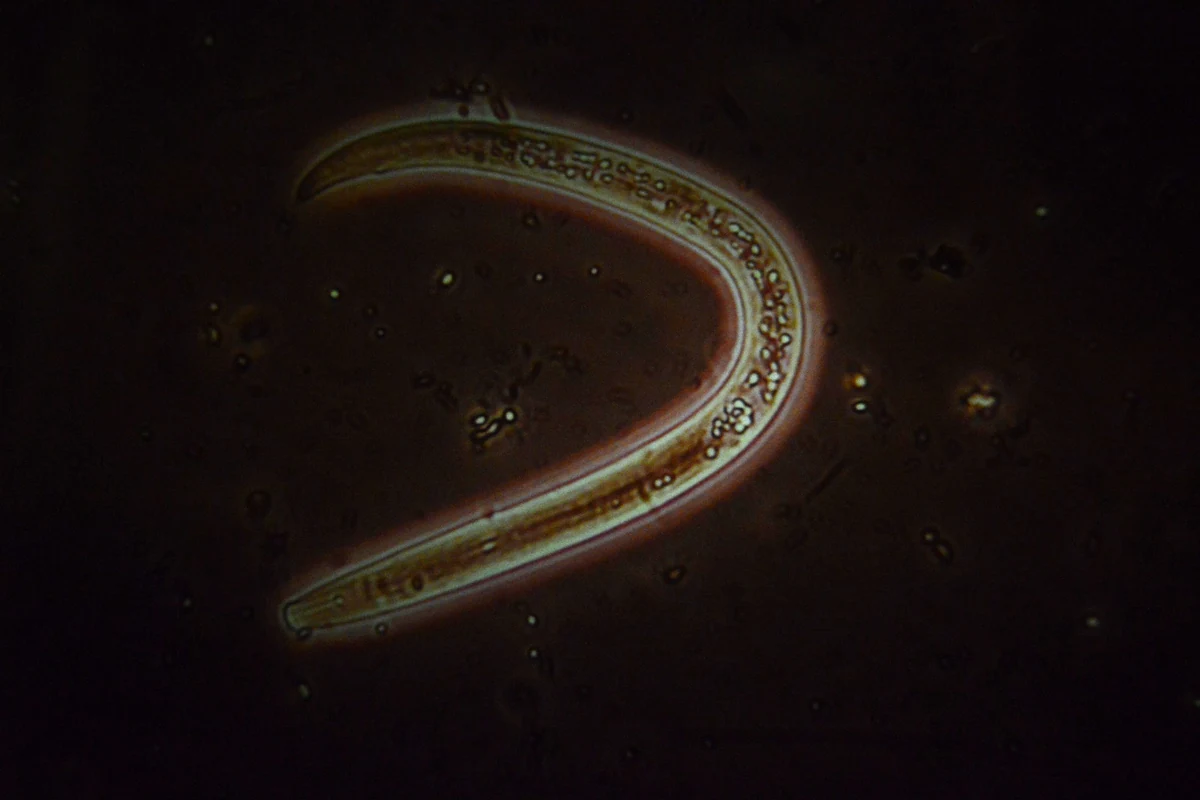
A team at the University of Cologne set out to fill in that mechanism. They chose Caenorhabditis elegans, a millimetre-long roundworm with a lifespan of weeks, and treated temperature as the single variable, watching the phenomenon first and then asking why at each turn. The result appears in Nature. A worm is not a person, but its conserved pathways often offer leads for human biology.
The design is simple. Wild-type worms develop to adulthood at 20 degrees Celsius, then are moved to 15, 20 or 25 degrees. On the fifth day of adulthood, metabolites are measured. That detail, changing temperature only after adulthood, matters: it separates the effect of cold from development and looks purely at how an adult animal adapts. It is the kind of control that makes a later causal claim possible. A design that cannot separate these effects would only ever deliver a correlation.
In the results, several metabolites rose in the 15-degree group, and one stood out: dihydrobiopterin, or BH2. The researchers did not stop at naming a molecule that went up. They asked where it came from. Under cold, the key enzyme that makes BH2, GTP cyclohydrolase I, known in the worm as CAT-4, increased in abundance, and its messenger RNA rose with it. Cold was promoting transcription, and transcription was driving enzyme production. It is a small but decisive change in the question being asked.
BH2 has no biological activity of its own, and that is the key to the whole chain. It is an intermediate in the synthesis of tetrahydrobiopterin, BH4, and behaves like a stable reservoir. BH4 is a cofactor for many enzymatic reactions but is chemically fragile and readily oxidised. BH2 is more robust, and when needed it can be converted into active BH4 through a salvage pathway, with dihydrofolate reductase, or DHFR-1, doing the conversion. Without that distinction, the list of rising metabolites would be a pile of names pointing nowhere.
The logic resembles a buffer design. Store an unstable active molecule in a stable intermediate form, then activate it on site when required. In the 15-degree environment, worm BH4 levels rose modestly and lifespan followed. The caution in that wording is worth keeping: a modest rise, not a surge; lifespan followed, not produced by BH4 alone. Biological causal chains rarely arrive with dramatic numbers. They accumulate, instead, from small shifts sustained over time. A reservoir that can be tapped locally is a design principle, not a one-off chemical curiosity.
What nails the hypothesis is the reverse test. The team suppressed cat-4 during adulthood with RNA interference, lowering CAT-4 production. Worm BH4 fell, and the lifespan extension delivered by the cold weakened markedly. That step is decisive. It moves the story from a correlation in which cold, BH2, BH4 and longevity appear together to a causal claim in which removing a middle link makes the effect disappear.
The paper also sketches a wider implication. The pathway does not merely extend lifespan; it suppresses the aggregation of harmful proteins associated with disease during ageing and helps maintain protein homeostasis in distal tissues. The phrase distal tissue is revealing. A signal switched on in muscle may influence how other parts of the body manage their proteins. Such cross-tissue effects are among the hardest and most absorbing questions in ageing research. None of that proves a mechanism on its own, but it sets the boundaries a future explanation will have to respect.
In people, the counterpart of CAT-4 is GCH1, the enzyme that catalyses the first and rate-limiting step of BH2 synthesis. That correspondence invites speculation about human health. It is also exactly where a brake is needed. A shared rate-limiting enzyme does not mean shared regulation, still less that a person who chills out will live longer. Worms and people are separated by hundreds of millions of years of evolution, and the experimental settings are not remotely comparable. The honest response is curiosity with the claim kept firmly at worm scale.

The researchers themselves name what remains open: it is still unclear in which tissues CAT-4 acts. Where a signal comes from, where it goes, and through which receptor it reaches distant tissue, any missing link leaves the mechanism a sketch. That is the honest shape of basic research. It offers a testable next step rather than a health tip to copy at breakfast. The map has a route drawn on it, and several blank squares. Naming the unknown is not a weakness of the paper; it is the part that lets somebody else continue.
I prefer to read the study as a demonstration of method. It does not hunt for a single longevity gene. It threads temperature, a metabolite, a rate-limiting enzyme, a cofactor and protein homeostasis into one intervenable chain, then pushes back on it with RNA interference. That complete loop, from phenomenon to mechanism and back to intervention, is worth more than another report that some factor correlates with a long life. Science often advances less by finding an answer than by learning which question can actually be put to a test.
For a non-specialist, the useful takeaway is probably not wear less. It is understanding that cold stimulation is not mysticism. Moderate environmental challenge does trigger conserved stress and metabolic pathways, and those pathways touch ageing and protein quality control. But the temperature, the duration and the people for whom it works are questions for population studies, not for pasting worm data onto yourself. The honest position sits between dismissal and imitation. Enthusiasm should wait for that evidence.
The right way to read the paper, then, is as a starting point. The chain, cold to CAT-4 to BH2 to BH4 to protein homeostasis, has been sketched. The next questions are whether it holds in mammals, where the acting tissue sits, and how wide the window is. A line that survives those checks would change how we talk about cold and ageing; one that does not would still have taught us how to ask. Until then, the more reliable lesson is that science explains why far more slowly than it tells us what to do.





Comments